

How Photographers and Videographers Can Benefit from AI (Without Losing Creativity)
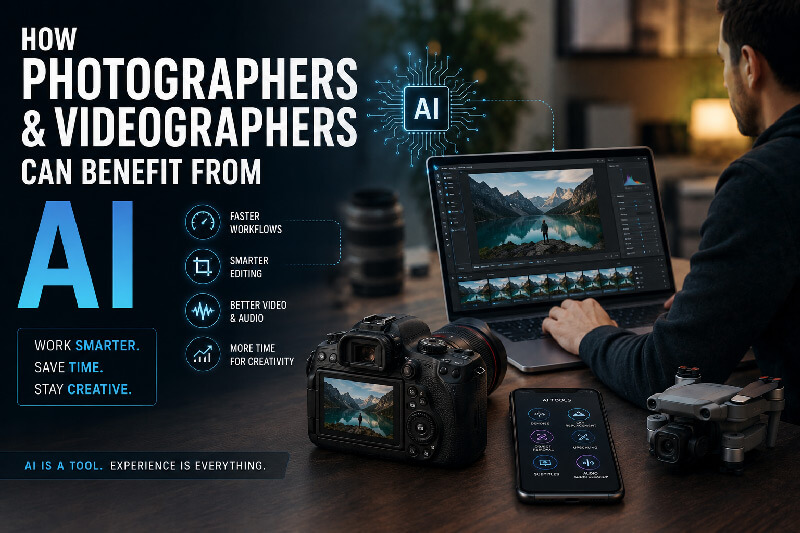
In this article I will be discussing how photographers and videographers can benefit from AI. Depending on who you listen to, AI is either about to replace photographers and videographers completely—or it is wildly overrated and just another passing trend.
The reality, in my experience, sits somewhere in the middle.
As someone who works professionally in photography and videography, as well as retouching and restoration, I have seen first-hand where AI can genuinely help—and where it still falls short.
The truth is simple:
AI is not replacing experienced photographers or videographers anytime soon. But it can absolutely make us faster, more efficient, and in some cases even more creative.
The key is learning how to use it as a tool rather than seeing it as a threat.
Table of Contents
Why AI Is Becoming Useful for Professional Photographers
One of the biggest misconceptions surrounding AI is that it is designed to replace photographers.
In reality, many of the best AI tools are designed to remove repetitive tasks so professionals can focus more on creativity.
For photographers, this can mean spending less time behind a computer and more time shooting, working with clients, or refining ideas.
This is where AI tools for photographers are beginning to make a real difference.
Used correctly, AI can help with:
- Faster photo culling
- Noise reduction
- Basic object removal
- Subject masking
- Colour matching
- Upscaling older images
- Faster editing workflows
The important thing to understand is this:
AI speeds up processes.
It does not replace creative judgement.
AI Photo Editing: Saving Hours of Work
Editing can often take longer than the actual shoot.
Wedding photographers, event photographers, and commercial photographers can easily return home with thousands of images after a single assignment.
This is where AI photo editing workflow improvements can save enormous amounts of time.
Software can now:
Cull Similar Images Faster
Instead of manually reviewing thousands of photos, AI can help identify duplicates, closed eyes, blurred images, or weaker compositions.
This does not mean handing over creative control—it simply means reducing the repetitive work.
Noise Reduction in Low Light
As someone who photographs orchestras in extremely low light conditions, I know how challenging noise can become.
AI-powered denoise tools are now surprisingly good at cleaning up images while preserving more detail than older methods.
Automatic Subject Selection
Masking subjects used to be incredibly time-consuming.
Now, software can quickly isolate people, skies, backgrounds, or clothing, speeding up local adjustments dramatically.
Again, it saves time.
It does not replace experience.
How Videographers Can Benefit from AI
AI is not only helping photographers.
There are now many excellent AI tools for videographers that improve workflow without replacing creativity.
For example:
Subtitle Generation
If you create promotional videos, interviews, tourism content, or social media reels, subtitles are often essential.
AI can now generate captions quickly, saving hours of manual typing.
Audio Cleanup
Background noise, wind interference, and poor audio quality can often be improved significantly with AI-assisted tools.
This is particularly useful for event filming or outdoor shoots.
Video Organisation
AI can identify people, scenes, or sections automatically—making editing much faster.
For anyone working on large productions or multiple-camera edits, this can be a huge time saver.
AI for Content Creation and Marketing
One area where I personally see enormous value is content creation.
If you run a photography or videography business, marketing often takes almost as much time as the creative work itself.
AI can help generate:
- Blog ideas
- Social media captions
- Video descriptions
- SEO suggestions
- Website copy inspiration
As a photographer or videographer, this means spending less time staring at a blank page wondering what to write.
That said, authenticity still matters.
People connect with real experience.
An AI-written article with no personal insight often feels generic. Adding real projects, challenges, and experience makes all the difference.
Where AI Still Struggles
This is the part many people forget.
Despite all the hype, there are still many areas where AI struggles badly.
Storytelling and Emotion
AI cannot anticipate emotion.
It cannot understand human chemistry at a wedding, sense tension before a performance, or recognise meaningful moments before they happen.
A skilled photographer reads situations instinctively.
That comes from experience—not software.
Creative Decision Making
Knowing where to stand, when to move, what lens to use, or how to direct people still requires human judgement.
AI does not know how to deal with unpredictable light, difficult weather, nervous clients, or fast-changing situations.
Consistency
If you have ever experimented with AI image generation, you have probably noticed something frustrating:
Faces change.
Details shift.
Objects become inconsistent.
Professional work demands reliability.
Clients expect accuracy.
Why Experience Still Matters
No amount of AI can replace experience gained from years of working with real clients.
Whether photographing concerts in near darkness, producing tourism campaigns, filming events, or photographing commercial spaces, experience teaches things software simply cannot.
This is why how photographers use AI matters more than whether they use it.
The best professionals are not replacing themselves.
They are simply becoming more efficient.
AI handles repetitive tasks.
Humans focus on creativity, storytelling, and client relationships.
That is where the real value still lies.
The Future: Smarter Workflows, Not Replacement
In my opinion, photographers and videographers who completely ignore AI may eventually struggle—not because AI replaces them, but because others become faster and more efficient.
At the same time, relying entirely on AI is equally risky.
The strongest approach sits somewhere in the middle:
Use AI to improve workflow.
But never let it replace creativity.
That balance is where the future of professional photography and videography is heading.
How photographers and videographers can benefit from AI – Final Thoughts
AI is already changing photography and video production.
But rather than fearing it, there are huge benefits in understanding how to use it intelligently.
For me, AI works best when it removes repetitive tasks, speeds up editing, improves workflow, and frees up more time to focus on creativity.
Because at the end of the day, cameras do not tell stories.
People do.
And that is something AI still cannot replicate.
Ready to Elevate Your Photography and Video Content?
Whether you are looking for professional photography, videography, or high-end visual storytelling for your business, tourism campaign, or event, feel free to get in touch.
Combining experience with the latest technology is often the best way to create stronger results.