

Why Authentic Experience Beats SEO Tricks
For years, photographers have been told that the secret to getting found online is SEO.
Choose the right keywords. Put them in your headings. Add them to your page titles. Write enough words. Get backlinks. Optimise your images. Repeat the process and, eventually, Google will reward you.
There is certainly truth in that.
SEO matters. If nobody can find your website, it doesn’t matter how good your photography is.
But after many years working as a professional photographer and videographer, and after watching how my own website content has performed, I have come to believe that something else is becoming increasingly important.
Experience.
Not claimed experience. Not carefully written marketing language saying that you are an expert.
Actual experience.
The difference is becoming particularly important as search engines become better at understanding the meaning and context of content, while AI-powered search systems increasingly try to identify genuine expertise rather than simply matching a few words on a page.
And this creates an interesting opportunity for professional photographers. And this is Why Authentic Experience Beats SEO Tricks
Table of Contents
SEO Can Help People Find You, But It Can’t Give You Experience
Let’s start with something important.
I’m not suggesting that photographers should ignore SEO.
I use SEO extensively myself. I research keywords, structure articles carefully, write useful page titles and descriptions, optimise images and think about how different pages on my website fit together.
But there is a limit to what SEO can achieve.
You can optimise a page for “professional photographer Spain” as much as you like.
You can write the phrase into your heading, introduction, image alt text and various parts of the article.
But none of those things actually make you a professional photographer.
They simply make it easier for somebody searching for one to discover you.
The experience has to come from somewhere else.
It comes from the assignments you have completed, the problems you have solved, the clients you have worked with and the knowledge you have accumulated over the years.
That is something you cannot manufacture by adding another keyword to a paragraph.
People Can Tell the Difference Between Experience and Marketing
One of the reasons I have increasingly moved towards writing experience-based articles is that they give me something much more valuable than another generic SEO page.
They give me something to talk about.
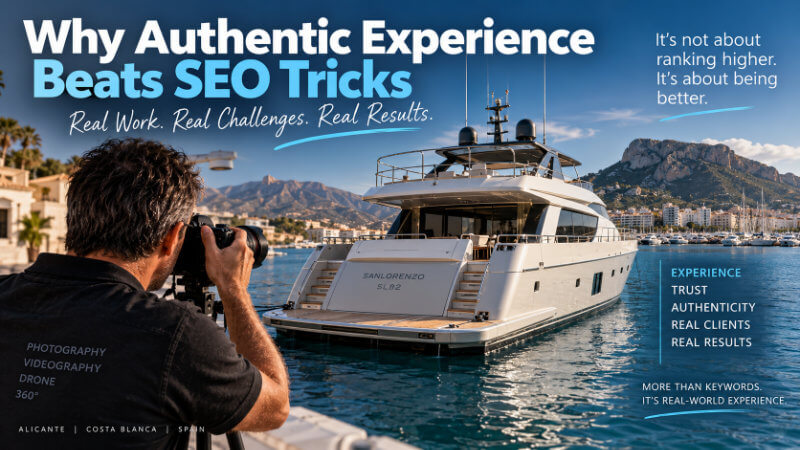
If I write about photographing a luxury yacht, I can explain what actually happened during the assignment.
I can talk about arriving before the yacht was launched, photographing it at the shipyard, dealing with changing weather, working around the harbour traffic and discovering that the planned drone photography wasn’t going to work as expected.
Those details aren’t something I could have invented simply by researching “luxury yacht photographer Spain”.
They came from actually being there.
That is what makes the content interesting.
And more importantly, it demonstrates experience without me having to repeatedly tell the reader that I am experienced.
Real Stories Are Difficult to Fake

This is where I think photographers have a significant advantage.
We have stories.
Every professional photographer who has been working for a reasonable amount of time has encountered difficult assignments, unexpected problems, unusual clients, challenging locations and situations where things didn’t go according to plan.
Those experiences are incredibly valuable content.
Imagine two photographers competing for the same client.
The first website says:
“We provide professional photography services using the latest equipment and deliver outstanding results for our clients.”
The second website explains how the photographer was asked to photograph a yacht that was being launched after a refit, arrived before the launch, photographed the vessel at the shipyard, worked around the changing weather and eventually had to abandon the planned drone photography because the conditions were unsuitable.
Which photographer sounds as though they have actually done the job?
The second one doesn’t need to tell you that they are experienced.
The story demonstrates it.
The Story Didn’t End There
Fortunately, that wasn’t the end of the story. Once the yacht had been cleaned and the remaining work completed, I returned to Alicante to photograph the parts of the assignment that we had been unable to complete on the first day, including the deck and the exterior from a range of angles. This time the conditions were right, the shoot was completed successfully and the client was happy with the final photography. The yacht is now officially on the market, with the photography being used as part of its sales presentation.
For me, this is exactly why I believe real experience is so much more valuable than simply writing about what a photographer supposedly knows. The original assignment didn’t go perfectly, but the important thing was returning, solving the problem and delivering what the client needed. That is the sort of experience that doesn’t need to be exaggerated or dressed up for SEO because the work itself provides the evidence.

Specific Details Create Authority
One of the things I have learned from writing about my own assignments is that the small details are often more powerful than the obvious ones.
It isn’t particularly interesting to say that a photographer knows how to deal with difficult lighting.
It is much more interesting to explain what happened when the lighting changed halfway through an assignment.
It isn’t particularly interesting to say that a photographer understands event photography.
It is more convincing to explain how you had to deliver hundreds of photographs on the same evening because the client needed them for press and social media while the event was still fresh.
It isn’t particularly interesting to say that you understand data management.
It is much more convincing to explain what happened when a memory card failed during an important assignment and you had to recover the photographs.
Real experience naturally produces specific details.
And specific details are difficult to reproduce with generic marketing copy.
Your Portfolio Only Shows the Finished Result
This is another reason I believe photographers should be writing about their work.
A portfolio shows the result.
It doesn’t necessarily show everything that happened before you pressed the shutter.
A photograph might look effortless.
The reality could have involved hours of preparation, difficult weather, complicated lighting, location scouting, equipment problems, difficult access or a client changing the brief halfway through the assignment.
The finished photograph doesn’t tell that story.
Your website can.
That transforms a portfolio from a collection of photographs into evidence of professional experience.
Instead of simply showing a photograph of a luxury property, for example, you can explain how you photographed it, what made the location difficult, what equipment you used and how you solved the problems you encountered.
That gives potential clients considerably more information when deciding whether you are the right photographer for their project.
Authentic Photography Content Builds Trust

There is also a psychological difference between seeing somebody claim expertise and seeing evidence of it.
If a photographer tells me they are highly experienced, I have no particular reason to believe them.
If they show me twenty years of assignments, explain the work they have undertaken and demonstrate how they dealt with difficult situations, I can make my own judgement.
That is much more powerful.
Authentic photography content allows potential clients to see how you think, not just what you produce.
And that matters because professional photography is rarely just about operating a camera.
Clients are hiring someone to solve a problem.
They may need photographs of a property that has awkward spaces.
They may need an event covered while dealing with hundreds of people and rapidly changing schedules.
They may need a yacht photographed in a particular harbour.
They may need photographs and video produced during the same assignment.
They may simply need someone who can turn up, understand the brief and get the job done without creating additional problems.
Your experience is evidence that you can do those things.
Location Experience Matters Too
This is particularly important for photographers working in specialist geographic markets.
Being a photographer in Spain isn’t simply about owning a camera and living in Spain.
Local experience matters.
Working across Alicante and the Costa Blanca means understanding the locations, the light, the weather, the architecture, the seasonal changes and the practical realities of working here.
A photographer who has worked repeatedly in Altea, Calpe, Moraira, Jávea, Denia, Benidorm and Alicante has accumulated knowledge that cannot be reproduced by simply putting those place names into a webpage.
That local knowledge becomes part of the service.
It can influence when a shoot takes place, where the best viewpoints are, how the light behaves and how an assignment should be approached.
A keyword might tell somebody that you are a Costa Blanca photographer.
Your work demonstrates whether you actually know the Costa Blanca.
The Unexpected Benefits of Writing About Your Experience
There is another benefit to experience-based content that I didn’t fully appreciate when I started writing more regularly.
It can attract clients you weren’t specifically targeting.
One of my assignments in Leeds is a good example.
I had written about the work I had undertaken there, and later discovered that a potential wedding client had found me partly because of that connection to Leeds.
That wasn’t necessarily the keyword I would have chosen if I had been sitting down with an SEO spreadsheet and trying to identify my next target.
It happened because a real piece of experience connected with a real person.
That is one of the things I find particularly interesting about publishing genuine case studies.
You don’t always know who is going to recognise themselves in the story.
A location, a previous client, a type of assignment or even a particular problem can become the reason somebody decides to contact you.
Experience Can Create Better SEO Naturally
There is also a practical SEO advantage to writing from experience.
Real assignments naturally contain relevant information.
A yacht shoot might include terms relating to yacht photography, marine photography, Alicante, drone photography, commercial photography, boat launches and professional photography.
A wedding assignment might naturally involve destination weddings, wedding photography, the Cotswolds, documentary photography, black and white photography and working with mature couples.
A difficult real estate assignment might naturally involve property photography, 360 photography, small spaces, wide-angle photography and Costa Blanca real estate.
You don’t necessarily have to force those keywords into the article.
They appear because they are relevant to the story.
This is what I mean by experience-based SEO.
The SEO supports the experience rather than the experience being manufactured to support the SEO.
AI Makes Authentic Experience Even More Valuable
This becomes particularly interesting as AI-generated content becomes increasingly common.
It is now possible to produce an apparently professional article about almost any subject in seconds.
That has obvious advantages.
AI can help photographers organise their thoughts, improve their writing, structure articles and turn rough notes into something readable.
I use AI myself for exactly these reasons.
But there is a fundamental difference between using AI to communicate an experience and using AI to invent one.
I can tell AI what happened during a yacht assignment and ask it to help me turn those experiences into an article.
What I cannot do is ask AI to give me ten years of real-world photography experience.
It can generate the language.
It cannot retrospectively stand on the harbour wall at 8:30 in the morning waiting for a yacht to launch.
It cannot experience the frustration of discovering that the weather has changed and the planned drone photography is no longer practical.
It cannot have a client standing beside it while a difficult decision needs to be made.
Those experiences belong to the photographer.
And that makes them valuable.
Don’t Write What You Think Google Wants to Read
One of the easiest traps in SEO is writing for the search engine rather than the person.
You start with a keyword.
Then you try to build an article around it.
Before long, the article becomes an exercise in satisfying SEO requirements rather than communicating something useful.
The result might technically be optimised.
But it can also sound like every other article on the internet.
I think the better approach is almost the reverse.
Start with something you actually know.
Start with an assignment.
Start with a problem you solved.
Start with something you learned.
Start with an opinion formed through years of doing the job.
Then structure that knowledge so that people can find it.
That is a much more natural approach to SEO.
Don’t Be Afraid to Talk About Things That Went Wrong
There is another lesson I have learned from writing about photography.
Some of the most interesting articles are about assignments that didn’t go perfectly.
Photographers sometimes feel that everything published on their website has to make them look flawless.
I disagree.
If a yacht shoot doesn’t go according to plan, that can make an excellent article.
If a memory card fails and you recover the photographs, that is an interesting story.
If a client changes the brief at the last minute, explain how you dealt with it.
If a particular piece of software lets you down, explain what happened.
If weather conditions force you to change your approach, explain the decision.
These stories demonstrate something that a perfect portfolio cannot.
They demonstrate how you behave when things become difficult.
And that is often what clients really want to know.
Professional Photographers Have More Content Than They Realise
One of the biggest problems I see with photography websites is that photographers assume they don’t have anything interesting to write about.
I think the opposite is usually true.
If you have been working professionally for five, ten, fifteen or twenty years, you probably have hundreds of potential articles sitting inside your own experience.
Every major assignment can potentially become a case study.
Every difficult client situation can become a lesson.
Every unusual location can become a location guide.
Every equipment problem can become a technical article.
Every successful project can become a behind-the-scenes story.
And every mistake can become something that helps another photographer avoid making the same one.
You don’t need to invent content.
You need to recognise the value of the content you already have.
Experience Is the Part of Your Website Nobody Else Can Copy
This may be the most important point.
Another photographer can copy a keyword.
They can target the same location.
They can create a similar service page.
They can use similar marketing language.
They can even produce an article on the same subject.
But they cannot copy your actual history.
They haven’t photographed the same clients.
They haven’t dealt with the same problems.
They haven’t stood in the same locations.
They haven’t made the same decisions.
They haven’t accumulated the same knowledge.
Your experience is therefore one of the few genuinely unique assets you have online.
Use it.
SEO Should Amplify Expertise, Not Replace It
I don’t think SEO and authentic content are opposites.
In fact, I think they work extremely well together when they are used properly.
SEO helps the right people discover your content.
Your experience gives them a reason to trust it.
Your photography provides evidence of your ability.
Your case studies demonstrate how you work.
And your personality gives potential clients an idea of who they might actually be hiring.
That is a much stronger proposition than simply ranking for a keyword.
The goal shouldn’t be to trick a search engine into thinking you are an expert.
The goal should be to make it easy for search engines, AI systems and potential clients to discover the expertise you already possess.
The Future Belongs to Photographers Who Have Something to Say
The photography industry has changed enormously during my career.
The technology has changed.
The cameras have changed.
The way clients find photographers has changed.
Social media has changed the way photographs are consumed.
And now AI is changing how people search for information.
But one thing hasn’t changed.
Experience still matters.
A photographer who has spent years working with real clients, solving real problems and producing real work has something valuable that cannot simply be generated by an algorithm.
The challenge is communicating that experience.
That is where your website and your content come in.
Don’t just tell people that you are experienced.
Show them.
Tell them what happened.
Explain what you learned.
Show them the photographs.
Talk about the decisions you made.
Explain the problems you solved.
And don’t be afraid to tell the stories where things didn’t go according to plan.
Those are often the stories that demonstrate your professionalism most clearly.
Authenticity May Be the Best SEO Strategy of All
There will always be new SEO techniques.
There will always be new ranking factors.
There will always be another algorithm update and another piece of advice telling you how to optimise your website.
Some of that advice will be useful.
Some of it won’t.
But there is one strategy that doesn’t really become outdated.
Have genuine experience.
Do good work.
Learn from it.
Document it.
And share what you know.
SEO can help people find you, but authentic experience gives them a reason to remember you.
For professional photographers, that may ultimately be far more valuable than any SEO trick.