

Why Portfolios Alone No Longer Win Clients
Table of Contents
Why Portfolios Alone No Longer Win Clients
For a long time, creative professionals were told one thing above all else: your work should speak for itself. Build a strong portfolio, show your best images, and clients will follow.
In reality, that advice no longer holds true — at least not on its own.
Today, many photographers, videographers, and creatives have impressive portfolios, yet still struggle to attract the right clients. The issue isn’t a lack of talent. It’s a shift in how people evaluate creative work, and how they decide who to trust.
A portfolio is still important — but it’s no longer enough.
The Problem With Portfolios in a Crowded Market
The creative industry has never been more saturated. High-quality cameras are widely accessible, editing tools are powerful and affordable, and social media is filled with visually polished content.
As a result:
Technical quality has become the baseline, not the differentiator
Many portfolios look equally strong at first glance
Clients struggle to understand what makes one creative different from another
From a client’s perspective, a gallery of beautiful images doesn’t always answer the most important questions:
Can this person understand my needs?
Do they have relevant experience?
Will they be easy to work with?
A portfolio shows what you’ve made — but not how you work, why you make decisions, or what problem you solve.
Clients Aren’t Buying Images — They’re Buying Confidence

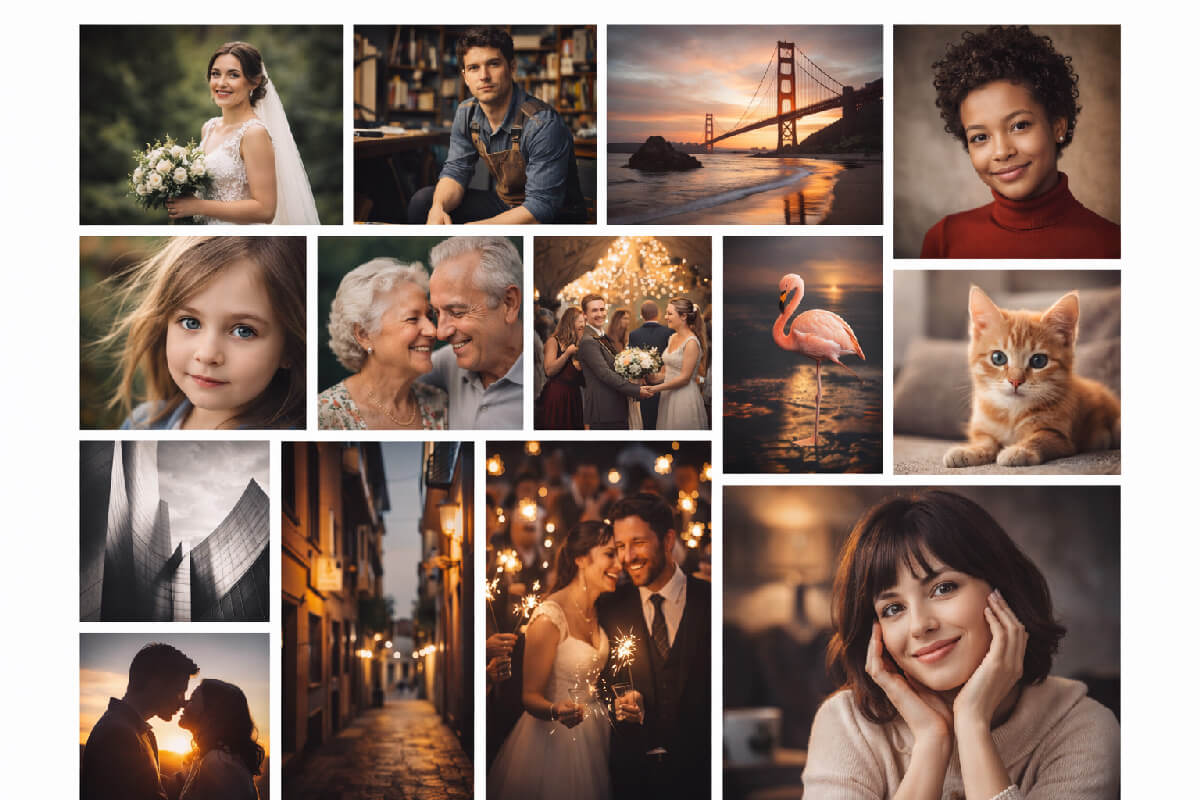
A collection of great photos is only part of a portfolio, these are lacking description and context
When clients hire a creative professional, they’re rarely just buying images or videos. They’re buying reassurance.
They want to know:
You understand their brief
You’ve handled similar situations before
You can adapt when things don’t go perfectly
You’ll deliver something that meets their expectations
A portfolio alone doesn’t communicate these things. It shows outcomes, not process.
This is why many clients now spend more time reading about a creative than looking at their work. They’re looking for signals of experience, clarity, and trust — not just visual style.
The Shift From Display to Explanation

The most effective creative websites today don’t just display work; they explain it.
They provide:
Context around projects
Insight into decision-making
Clear descriptions of roles and responsibilities
Reflections on challenges and outcomes
This extra layer of explanation does two things. First, it helps potential clients understand how you think. Second, it helps modern search systems — including AI-driven search — interpret your expertise more accurately.
A portfolio without context is visually impressive, but informationally thin. In the above example image, is an extract from my corporate event photography portfolio, I always include a detailed description of the photographic assignment.
Why AI Search Engines Reinforce This Shift
According to Forbes, AI-driven search engines are changing how customers find businesses, with traditional organic search traffic declining and conversational AI summarising key information directly—making clear, authoritative, and discoverable content more important than ever.
As AI-powered search tools become more prominent, the limitations of portfolio-only websites become even clearer.
AI systems don’t “see” images the way humans do. They rely heavily on text, structure, and clarity to understand:
Who you are
What you do
What you’re experienced in
Who your work is relevant for
A site made up entirely of images and minimal captions gives AI very little to work with. Even if the work is excellent, the expertise behind it remains largely invisible to automated systems.
By contrast, a site that combines visuals with thoughtful explanation provides a much stronger signal of authority and relevance.
Portfolios Don’t Show Process — And Process Is Everything
One of the biggest gaps in portfolio-only websites is the absence of process.
Clients want to know:
How you approach a project
How you collaborate
How you handle revisions or unexpected issues
How involved they need to be
Process builds trust because it reduces uncertainty. When people understand how something will unfold, they feel more comfortable committing.
This is especially true for higher-value or more complex projects, where the risk feels greater from the client’s perspective.
Experience Lives Between the Images

Experience doesn’t just show up in finished work — it shows up in how you talk about that work.
When creatives share:
What went wrong on a shoot
How they adapted under pressure
Why they made certain creative choices
What they learned from a project
They demonstrate real-world experience in a way that images alone cannot.
This kind of insight separates professionals from hobbyists, even when the visual output looks similar.
What Clients Actually Look For Now
Today’s clients are more informed, more cautious, and more comparison-driven. They’re not just browsing portfolios — they’re evaluating people.
They’re looking for:
Clarity of role and expertise
Evidence of problem-solving
A sense of professionalism and reliability
Someone who understands their context
A portfolio opens the door. The rest of your content determines whether they step through it.
Portfolios Still Matter — Just Not Alone
None of this means portfolios are obsolete. High-quality work is still essential. But portfolios now function as supporting evidence, not the entire argument.
The strongest creative websites balance:
Visual proof
Clear explanations
Thoughtful insight
Human presence
Together, these elements create confidence — for clients and for modern search systems alike.
Why Portfolios Alone No Longer Win Clients – Moving Beyond “Just Show the Work”
If your website relies solely on images to do the talking, you may be unintentionally limiting your reach. Not because your work isn’t strong, but because you’re not giving people enough information to trust what they’re seeing.
In a landscape shaped by AI-driven search discovery for creatives and increasingly selective clients, clarity beats silence. Explanation beats assumption. And experience, when shared thoughtfully, beats even the most polished portfolio.
A portfolio shows what you can do.
Your words show why it matters.
Frequently Asked Questions
Are portfolios still important for photographers and creatives?
Yes — portfolios still matter, but they’re no longer enough on their own. A portfolio shows what you can produce, but it doesn’t explain how you work, why you make certain decisions, or what it’s like to work with you. Clients increasingly look for context, process, and proof of experience alongside strong visuals.
Why portfolios alone no longer win clients anymore?
Because most clients now see dozens of similar portfolios online. What separates one creative from another isn’t just image quality, but clarity, trust, communication, and demonstrated experience. Clients want reassurance that you understand their needs, not just that you can create attractive work.
How has AI changed the way clients find creative professionals?
AI-driven search engines and recommendation systems summarise expertise rather than ranking individual images. They prioritise clear explanations, experience, and authority signals — things that standalone portfolios often lack. Creatives who explain their work and process are more likely to be surfaced by AI discovery tools.
What should creatives add alongside their portfolio?
Strong supporting content such as:
Case studies
Behind-the-scenes insights
Blog articles explaining your approach
Clear service explanations
Personal experience and decision-making context
These elements help both clients and AI systems understand your value beyond visuals.
Does explaining my work really make a difference?
Yes. Explanation builds trust. Clients want confidence that you can solve their problem, not just recreate past work. Clear explanations also help AI systems interpret your expertise accurately, improving visibility in modern search environments.
Is this about SEO tricks or gaming algorithms?
No. This shift isn’t about manipulation — it’s about clarity. The same content that helps AI understand your expertise also helps real people decide whether to work with you. Good visibility now comes from authenticity, experience, and explanation, not keyword stuffing.
What’s the biggest mistake creatives make with their websites today?
Assuming their work should “speak for itself.” In reality, clients want guidance, reassurance, and insight. The most effective creative websites combine strong visuals with clear narrative and professional context.
How can I future-proof my creative website?
By focusing less on presentation alone and more on communication:
Explain your process
Share experience-driven insights
Write content that supports your portfolio
Build a clear personal brand
This approach works for both human clients and AI-driven discovery.